
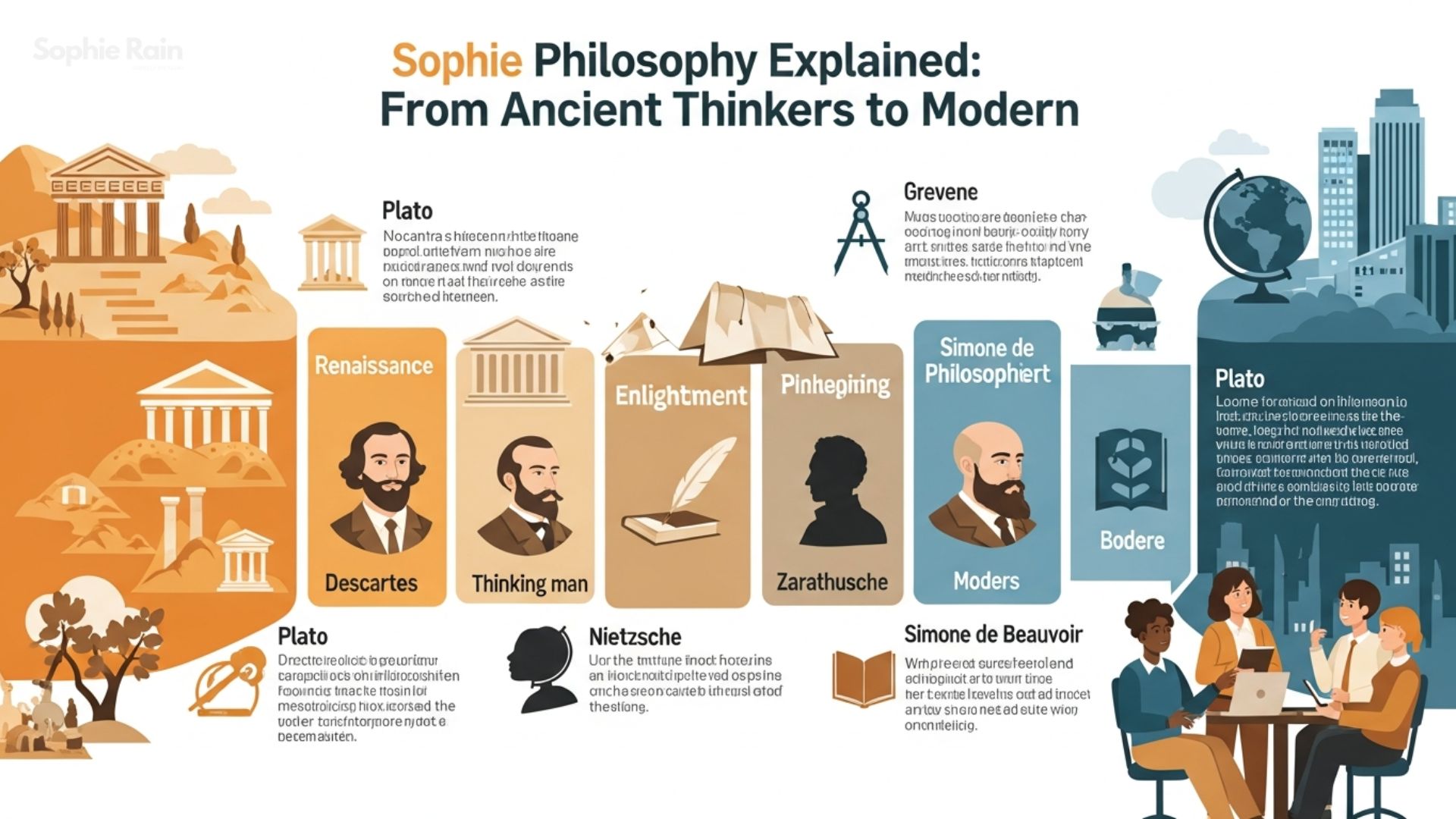
Sophie Philosophy Explained: From Ancient Thinkers to Modern
Hey there! Imagine getting a mysterious letter in your mailbox that asks, “Who are you?” That’s exactly how Sophie philosophy kicks off in Jostein Gaarder’s famous book, Sophie’s World. If you’ve ever wondered about life’s big questions – like where the world comes from or what reality really is – this story is your perfect starting point. It’s not just a novel; it’s a sneaky way to learn the history of philosophy without feeling like you’re in a boring classroom.
As someone who’s flipped through philosophy books and felt lost in fancy words, I get it. Sophie philosophy makes it all feel like an adventure. Written back in 1991, this Norwegian gem has sold over 40 million copies worldwide. It’s been translated into more than 60 languages, proving it’s a hit for teens and adults alike. In this post, we’ll dive into what makes Sophie philosophy so special, why it’s a great intro to Western philosophy, and how it can spark your own wonder about the universe. Let’s jump in!
What Is Sophie Philosophy All About?
Sophie philosophy isn’t some dusty old theory – it’s the heart of Sophie’s World, a book that mixes a thrilling story with lessons on thinkers from ancient times to now. Picture this: A 14-year-old girl named Sophie Amundsen finds weird notes at home. They lead her to Alberto Knox, a mysterious teacher who guides her through philosophy’s greatest hits.
The book starts simple, like explaining how early thinkers ditched myths for logic. It builds up to mind-bending ideas about existence and free will. What I love is how it feels real – Sophie’s just a regular kid, dealing with school and family, while her mind explodes with questions.
This approach makes Sophie philosophy super accessible. Unlike heavy textbooks, it uses everyday examples. For instance, atoms are compared to Lego blocks – easy to picture, right? If you’re new to philosophy for beginners, this is your gateway. It covers everything from Socrates to Sartre, all wrapped in a mystery that keeps you guessing.
The Story Behind Sophie Philosophy: Meet the Characters
Let’s chat about the people who make Sophie philosophy come alive. Sophie is our hero – curious, brave, and totally relatable. She’s like that friend who questions everything at a sleepover. Her journey starts with those cryptic letters, pulling her into lessons that challenge her world.
Then there’s Alberto Knox, the wise mentor. He’s patient, a bit quirky, and drops knowledge like a cool uncle telling stories by the fire. Their chats feel natural, not preachy. And don’t forget Hilde – another girl whose story twists everything. Her dad, Albert Knag, is like a puppet master, adding layers of “What if we’re all in a book?”
These characters show real-life philosophy in action. Think about it: Have you ever argued with a parent about rules, like Sophie does with her mom? That’s ethics right there! Gaarder, the author, draws from his own teaching experience to make it feel authentic. He’s a former philosophy teacher, so he knows how to explain tough stuff without overwhelming you.
A Quick History of Philosophy in Sophie Philosophy
Sophie philosophy shines by walking you through Western philosophy step by step. It starts with the basics and builds up, like climbing a ladder of ideas. No need for a degree – just curiosity.
The book kicks off with pre-Socratic thinkers, like Thales, who wondered if everything was made of water. Sounds silly now, but it was a big shift from gods and magic. Then comes Socrates, urging us to examine our lives. Plato’s cave? It’s like being stuck watching shadows on a wall, missing the real world outside.
Aristotle brings balance with his “golden mean” – not too much, not too little. Fast-forward to Descartes: “I think, therefore I am.” That’s a game-changer for doubting everything.
What sets Sophie philosophy apart is the analogies. Hegel’s dialectics? Like a river flowing, twisting through history. It’s deep but explained so simply, even a kid could nod along.
For a clearer view, here’s a handy table summarizing the key thinkers in the book:
| Era/Thinker | Key Concepts | Fun Analogy from the Book |
|---|---|---|
| Pre-Socratics (e.g., Thales, Democritus) | Natural explanations; atoms as basics | Atoms like Lego blocks |
| Socrates | Self-examination; unexamined life not worth living | Dialogue for truth-seeking |
| Plato | Theory of Forms; cave allegory | Ideas as perfect molds; shadows vs. reality |
| Aristotle | Ethics, logic, empiricism | Golden mean in virtues |
| Middle Ages (Aquinas) | Faith meets reason | Bridging old ideas with Christianity |
| Descartes | Doubt and certainty; “Cogito ergo sum” | Foundation of modern thought |
| Empiricists (Locke, Hume) | Knowledge from experience | Mind as a blank slate |
| Berkeley | Idealism: Reality in the mind | Pivotal to the story’s twist |
| Kant | Categorical imperative | Bridge between reason and senses |
| Hegel | Dialectics: Thesis-antithesis-synthesis | History as a progressing spirit |
| Kierkegaard | Existentialism; leap of faith | Individual choices over systems |
| Marx | Class struggle; critique of capitalism | Influence on society |
| Darwin | Evolution | Challenge to old views |
| Freud | Unconscious mind | Psychology in philosophy |
| Sartre | Existence precedes essence | Freedom and responsibility |
| Modern (Big Bang) | Universe origins | We’re all stardust |
This table pulls straight from the book’s structure, making it easy to see how ideas connect. Sophie philosophy doesn’t just list facts; it shows how they shape our world today.
Why Sophie Philosophy Sparks Wonder in Everyday Life
Ever stared at the stars and felt tiny? That’s the “faculty of wonder” Gaarder talks about in Sophie philosophy. Babies have it naturally – everything’s amazing! But as grown-ups, we lose it amid bills and routines.
The book reminds us to get it back. Through Sophie’s eyes, we see philosophy in simple things. Like questioning why we follow rules (hello, Kant’s imperatives) or pondering if dreams are real (thanks, Descartes).
In my experience, reading Sophie philosophy changed how I chat with friends. We debate free will over coffee, using examples from the book. It’s not stuffy – it’s fun! Compare it to other intros: Bertrand Russell’s history is great but dry. Sophie philosophy adds story magic, making it stick.
Experts agree it’s effective for young readers. Reviews on Goodreads call it “mind-expanding,” though some say the plot gets weird. That’s fair – the metafiction twist, where characters realize they’re in a book, echoes Berkeley’s ideas. It might feel contrived, but it drives home that reality could be an illusion.
Adaptations and Lasting Impact of Sophie Philosophy
Sophie philosophy isn’t stuck in pages. It’s jumped to screens and more! A 1999 Norwegian film and TV series brought the story to life, though they’re hard to find outside Europe.
Newer graphic novels from 2022-2023 by Vincent Zabus and Nicoby make it visual – perfect if you love comics. Even bands like Spiritualized nod to it in albums. That’s cultural staying power!
Globally, it’s won awards like the Deutscher Jugendliteraturpreis. For teens, it’s a bestseller that sparks lifelong curiosity. But heads up: Some parents worry about Sophie meeting Alberto alone. In real life, always be safe with strangers – that’s my disclaimer.
Compared to other philosophy books for beginners, Sophie stands out. It’s not as deep as primary sources, but it’s a bridge. Follow up with Russell’s A History of Western Philosophy for more.
Real-Life Lessons from Sophie Philosophy
Applying Sophie philosophy? Start small. Next time you’re puzzled by news, think like Hume: Is it cause and effect, or just habit?
Or channel Sartre: Your choices define you. I once used this to quit a bad habit – realizing existence precedes essence gave me power.
Environmentally, the book hints at appreciating our cosmic spot. We’re all from the Big Bang, sharing stardust with stars. That insight? Priceless for feeling connected.
Critics note biases, like downplaying Christian thinkers. Gaarder leans secular, but it’s not misleading – just one view. For balance, read Aquinas directly.
Wrapping Up the Adventure in Sophie Philosophy
Whew, what a ride through Sophie philosophy! From mysterious letters to escaping a book’s pages, Sophie’s World turns philosophy into an unforgettable story. It’s sold millions for a reason: It makes big ideas feel small and approachable. Whether you’re a teen pondering your place or an adult rediscovering wonder, this book delivers.
So, grab a copy and start asking those questions. Who knows? You might see the world anew. Remember, philosophy isn’t about answers – it’s about the thrill of wondering. Thanks for joining this journey; let’s keep the conversation going in the comments!
FAQ
Q: What is Sophie philosophy in simple terms?
A: Sophie philosophy refers to the core ideas in Jostein Gaarder’s Sophie’s World, a novel that teaches Western philosophy through a young girl’s story. It covers thinkers like Plato and Sartre using easy analogies, sparking curiosity about life, reality, and existence. Perfect for beginners, it blends mystery with timeless questions to make learning fun and engaging.
Q: How does Sophie philosophy introduce history of philosophy?
A: In Sophie philosophy, the history of philosophy unfolds chronologically via letters and lessons to Sophie. From ancient Greeks like Socrates to modern existentialists like Kierkegaard, it uses real-life examples and metaphors. This approach demystifies complex concepts, helping readers grasp evolution of thought without overwhelming details.
Q: Is Sophie philosophy good for philosophy for beginners?
A: Absolutely! Sophie philosophy excels as an intro for beginners by weaving philosophical concepts into a metafictional tale. It simplifies ideas like Plato’s Forms or Kant’s imperatives with stories, avoiding jargon. Many teens find it mind-opening, though follow up with deeper texts for full expertise.
Q: What are key themes in Sophie philosophy book
A: Key themes in the Sophie philosophy book include the faculty of wonder, layers of reality, and free will. Drawing from thinkers like Berkeley and Sartre, it explores parent-child dynamics and humanism. The narrative encourages questioning everyday life, promoting environmental awareness and personal growth through engaging storytelling
Q: Why read Sophie philosophy by Jostein Gaarder?
A: Read Sophie philosophy by Jostein Gaarder for its unique mix of adventure and education. This bestseller, translated into 60+ languages, makes Western philosophy accessible via Sophie’s journey. It addresses pain points like confusion over big questions, offering insights that inspire lifelong thinking in a friendly, non-intimidating way.